Raised garden bed plans that hold the soil
Set the length, width and height of your raised bed, and Woodworker works out the boards, corner posts and any middle posts needed to stop the sides bulging under wet soil.
Open the raised garden bed designerFree · no sign-up · works in your browser
How the design works
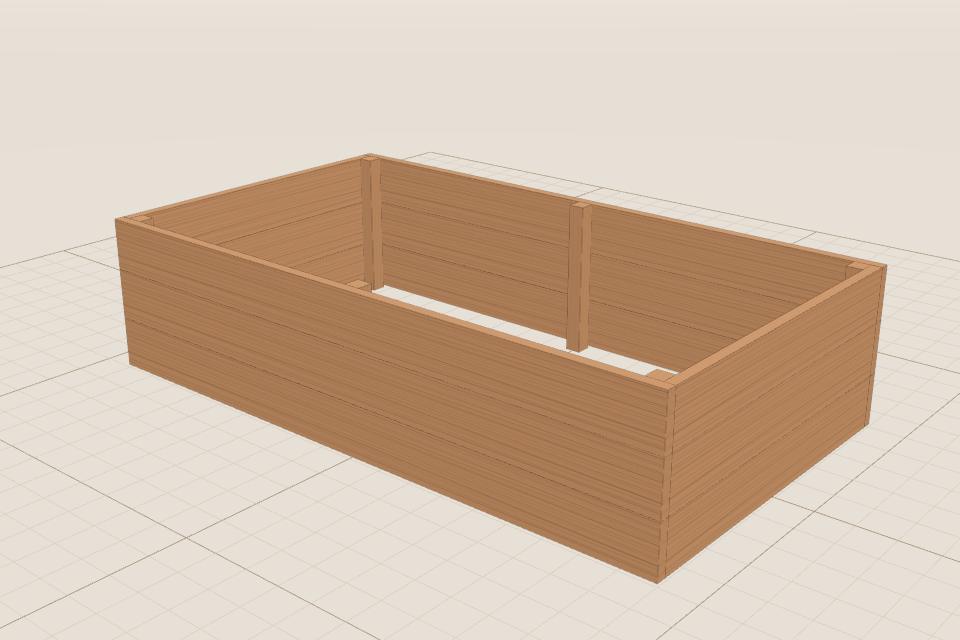
Boards are stacked on edge and screwed to posts inside the corners, with extra posts along long sides. The bed stands a little off the ground and is open at the bottom.
Starts at 1.8 × 1.0 m and 450 mm high (6 × 3 ft in US sizes). Change any size and everything else follows.
What Woodworker checks
- Boards bending outwards under the weight of wet soil
- Screws pulling out of the posts
- How far apart posts can be before the sides bulge
- Whether the wood lasts in contact with damp soil
When something isn’t strong or stable enough, it says why and offers a fix you can apply in one click, like a bigger section, an extra brace or a different joint.
What you can change
- Length, width and height (in whole boards)
- Board and post sizes
- How far apart the posts can be
- Soil weight (Advanced)
What you get
- A cut list of every part, with sizes, wood and how many
- A shopping list of timber lengths or sheets, screws, bolts and hardware, with rough costs
- Assembly steps in build order, with the joints and fixings for each step
- Dimensioned front, side and top drawings, and a printable workshop sheet (PDF)
Tips
- About 1.2 m (4 ft) wide lets you reach the middle from both sides.
- Line the inside of the boards (not the bottom) with pond liner to keep them drier for longer.
- Larch, cedar, oak or pressure-treated wood last far longer in contact with soil.
Questions
- Can I put the beds on my garden plan?
- Yes. Export → Send to Garden Planner places the bed in the free Garden Planner at its real size.
- Is it really free?
- Yes. Woodworker is free, with no ads and no account. Designs are saved in your browser and never uploaded.
- How accurate are the checks?
- They use Eurocode 5 methods and common furniture test loads, as a guide for home-made projects, not certified engineering. Ask an engineer about anything large or anything people could be hurt by if it failed.